Learn to Play Irish Tunes for Harp Therapy
Irish tunes☘️are the perfect (enchanting!) music for therapeutic harp.
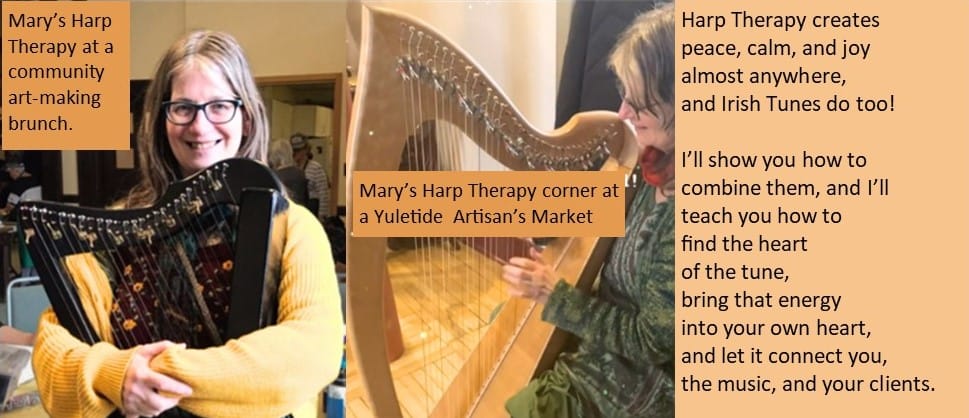
I created this self-paced course to share everything I’ve learned about
the healing magic and beauty
of Irish tunes.
“This is going to help the harp therapy community in so many ways! Supportive, interesting, well-paced…short videos, invitations to meditate and listen to the music, great stories.” Helen Morrison, Director, Therapy Harp Training Program
Included in this course
- Learn four complete tunes in simple arrangements uniquely suited to harp therapy
- Learn Irish harp basics
- Learn about modes and modal ethos for therapy harp
- Understand the four Irish modes and how to play them
- Explore improv possibilities with each mode and tune
- Learn left-hand ideas and work with unaccompanied melody
- Explore and practice therapy harp meditation techniques
- Read about the story and history of each tune
- Discover and practice breathing techniques with each tune
“Very reasonable, generous price for a huge wealth of resources–a fabulous bargain and wonderfully organized. I was really impressed! It’s amazing!”
H. Gonçalves, harpist, multi-instrumentalist, composer & educator
Watch this video for a quick overview of the full course!
Watch this video collab with Breeze Pics to experience some of the therapeutic techniques and tunes I teach in this course.
“The most interesting, engaging, and motivating music course I’ve seen.” Bernadette Meyers, artist, author, and Irish Tunes for Harp Therapy student
Many ways of learning
- Simple notation and chords for each tune
- Meditation videos so you can experience the tunes as a client
- Directed listening to help you learn naturally
- Close-up video demonstration of tunes
“As a vocalist, I found the breathwork section so interesting and enlightening.” Annette, Irish Tunes for Harp Therapy student and therapeutic musician
Is this course for you?
- You are interested in harp therapy
- You want to add to your harp therapy knowledge
- You play the harp
- You play another instrument and would love to learn therapeutic techniques with Irish tunes
- You can read simple music –OR–
- You are comfortable learning (slowly!) by ear
- You would love to expand your repertoire of therapeutic music
- You want to learn about the healing magic and beauty of slow Irish tunes!
“The application suggestions are so helpful. Playing the harp in this calm way helps me play and receive peace.” Robin Timbrall, Irish Tunes for Harp Therapy student and therapeutic musician
Learn more here ☟
Watch this video for a conversation about Harp Therapy and to see aspects of my Harp Therapy practice in action.

Questions? Contact me here
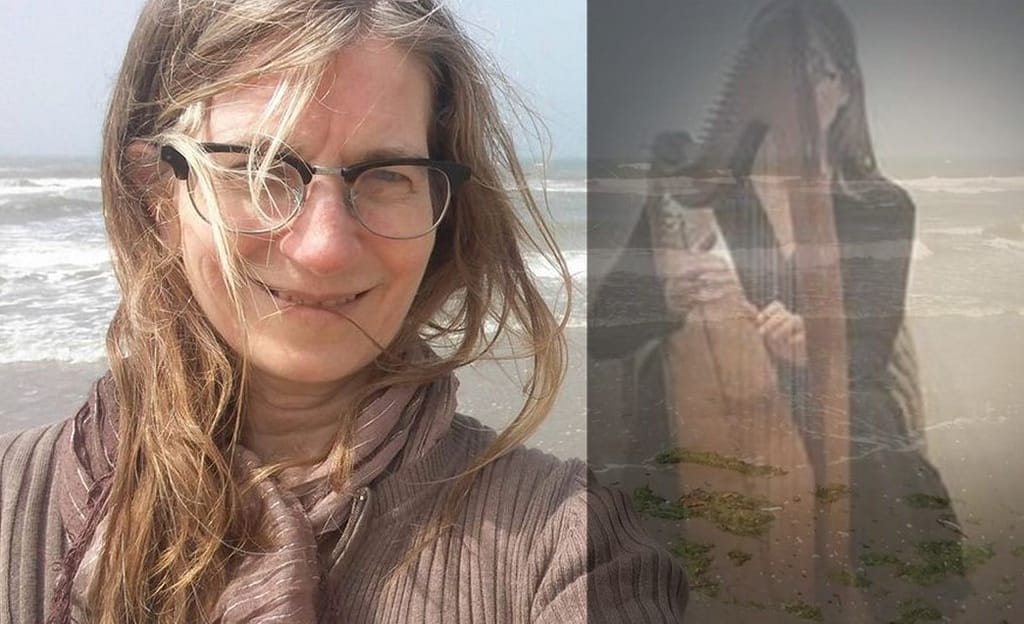
More about me
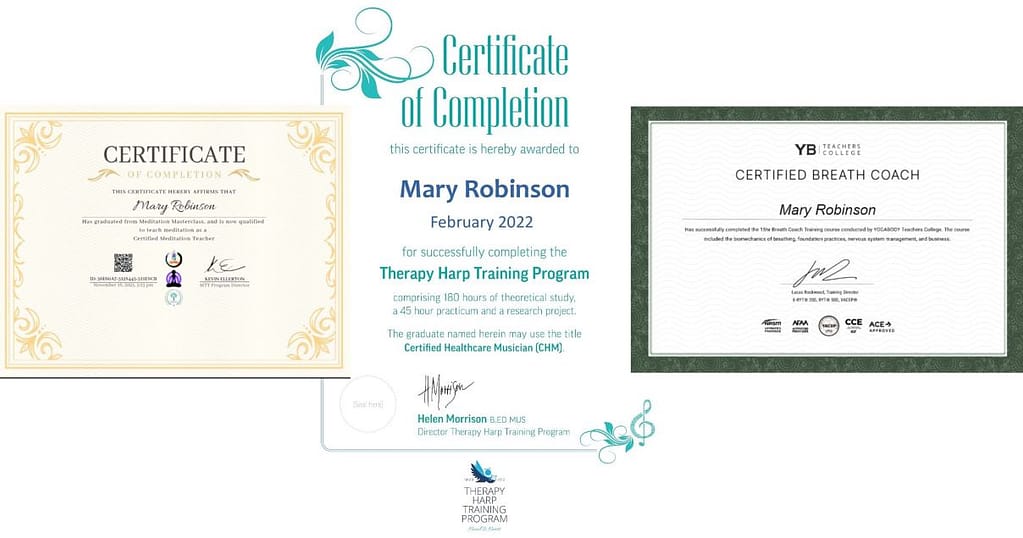
I am a Certified Healthcare Musician, Certified Breath Coach, Certified Trauma-Informed Coach, and Certified Meditation Coach.
My degree in Religious Studies incorporated specialized work in communication and awareness with the Palliative Care Team, teaching me to reach people where they are in many circumstances.
I play Irish harp and sing the Irish airs my Nana sang, I studied classical music (piano, voice, violin, and theory) with the Royal Conservatory of Music and received extensive liturgical and pastoral music training through the Ontario Liturgical Commission.
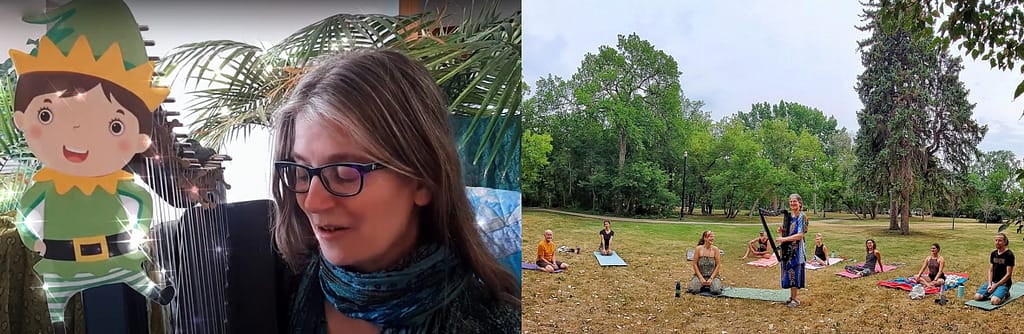
I teach harp, singing, piano, and music theory, always with an emphasis on therapeutic music applications. I specialize in slow Irish tunes for harp and offer harp therapy sessions for private clients, yoga classes, community art-making, meditation, and other gatherings.
Questions? Contact me here
What people say about my work
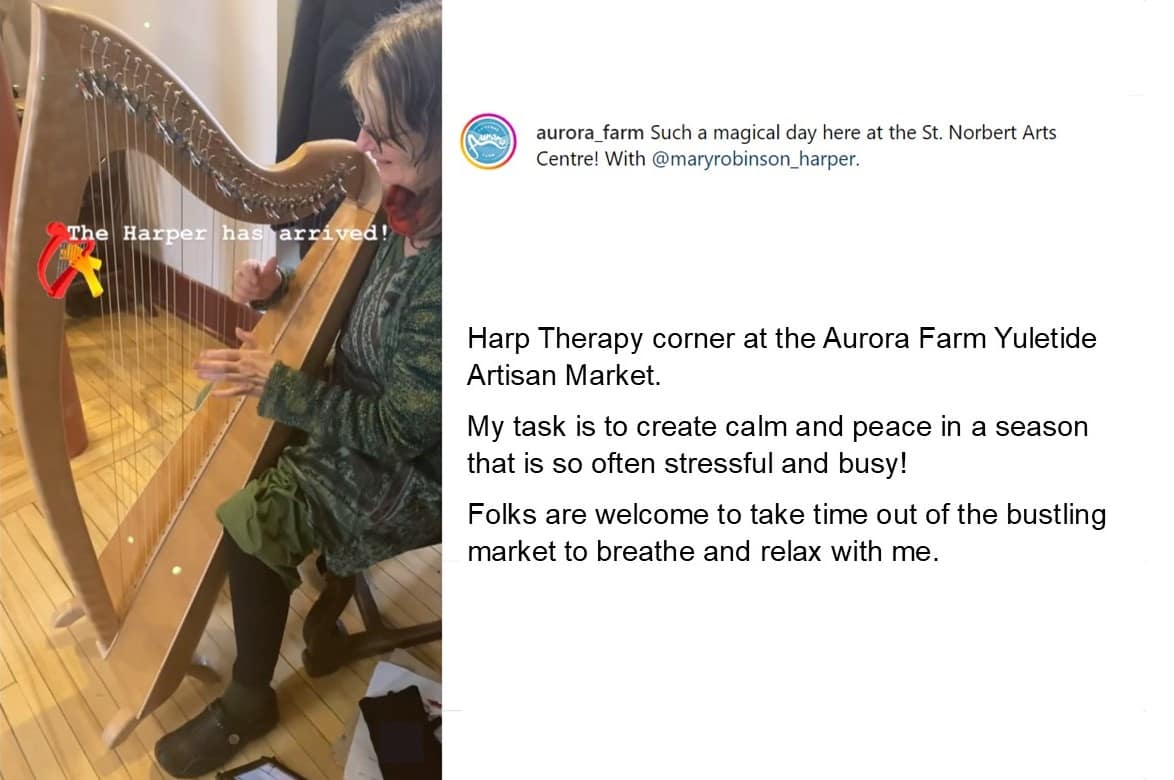
People who experience my Harp Therapy sessions often share their responses and tell me stories of how my music affects and changes them. I learn from every comment, and I created this course to share with you all that I have learned.
“This course is simply wonderful. Your historical notes bring context to the study, and you have translated something of your soul through the personal, anecdotal stories. Your teaching comes across as encouraging and empowering. The content is challenging because it’s clear that you have a great depth of knowledge about your topic, but it’s not overwhelming.”
Bernadette Meyers, Fine Art Photographer and Irish Tunes for Harp Therapy student
“Mary plays the harp beautifully. She is focused, gentle, and unassuming, allowing the recipient to take in the music in an undistracted way and easily enter a relaxed state. Participants were calmer, more tranquil, and mindfully in the moment when she played. Mary facilitates healing for the listener/patient and takes what she does seriously. She clearly cares deeply about the well-being of those she treats with her music, and is dedicated and passionate about it.” Jesse Singer, MSW
“She did a wonderful job of reflecting the moods of the meditations and exercises, very spontaneous, creative, free-flow. I can rely on Mary to truly support the participants and the work I am doing.” Melissa Boothroyd, RMT
“Mary is very in tune with her environment and easily matches the flow of music with the yoga movements. This lets the clients have a true releasing experience in mind, body, and spirit.” Kayla Chafe, Certified Fitness and Yoga Instructor
Mary’s strength is in her knowledge of music and understanding of its effect on listeners, her strong awareness of the Story Time group’s state of mind, and her ability to deliver an appropriate atmosphere and mood to her audience. The children’s mood becomes calm and focused during her singing and harp playing.” Anne Longe., BEd., Public Library Children’s Programming Supervisor
Questions? Contact me here
Irish Tunes for Harp Therapy Syllabus
Welcome Video
Who I am—What I do—The experience
Foundation (section one) Introduction Video
Why Irish Tunes?
Why I chose these four tunes
Meditation Video Respite Moment (Out on the Ocean-Tune #3)—Play-along Tips (rhythm—mode—first note—basic chords)
The Importance of Stories
Meditation Video Respite Moment (Gander in the Pratie Hole-Tune #3)—Play-along Tips (rhythm—mode—first note—basic chords)
Story Lessons from Melvin the Therapy Dog
Meditation Video Respite Moment (Gander Improv-Tune #3)—Play-along Tips (rhythm— mode—first note—basic chords)
The Importance (or not!) of Tune Names
Irish Style Video
Meditation Video Respite Moment (Pig Improv-Tune #1)—Play-along Tips (rhythm—mode—first note—basic chords)
Jig Rhythm
A closer look at Irish rhythm
Meditation Video Respite Moment (The Price of My Pig-Tune #1)—Play-along Tips (rhythm— mode—first note—basic chords)
Written notation, keys, and modes
A classical fix?
Writing chord names
Meditation Video Respite Moment (Ocean Improv-Tune #3)—Play-along Tips (rhythm— mode—first note—basic chords)
Accompaniment
What chords should I use? Should I even use chords?
Key and mode left-hand suggestions
Modes Video
The idea of modal ethos
Modes now and then
Western system of modes
Looking for in-depth exploration?
Meditation Video Respite Moment (A Fig for a Kiss-Tune #4)—Play-along Tips (rhythm— mode—first note—basic chords)
What about Irish Modes?
Meditation Video Respite Moment (Fig Improv-Tune #4)—Play-along Tips (rhythm— mode—first note—basic chords)
What are the four Irish modes?
Breathwork Video
Breathe in 4/4—calming your nerves
Breathing with the harp
Why nose breathing?
Meditation metronome—another way of breathing
Metronome breath video—walking to the beat—your internal metronome heartbeat—your musical, responsive metronome—breathe like a singer
Tools
Musescore—Blank manuscript paper—Notation notebook—Regular notebook—Metronome—Recording device—Writing Tools—online harp help
Bibliography
Complete bibliography includes books, journal articles, websites, and interviews
The Tunes (section two)
The Price of My Pig * Gander in the Pratie Hole * Out on the Ocean * A Fig for a Kiss
Each tune includes
Introduction Video
Tune Story—learning about the background, origin, and associations of the tune
Practice—apply your learning
Meditation Video of the tune and commentary on its use in therapeutic music
Improv demonstration
Levers, Mode, Rhythm, Phrasing—theory and practice of the technical aspects of the tune
Tune notation
Breathwork techniques for the unique characteristics of each tune
Mode history, theory, and ethos
In Context—therapeutic applications for this tune